
According to the common European framework
The Common European Framework of Reference for Languages establishes a scale of 6 common levels of reference for the organisation of language learning and for the accreditation of the different diplomas issued by certified bodies. The division is grouped into 3 blocks which correspond to a more classical division of basic, intermediate and advanced levels, although they do not correspond exactly to the classical levels because they are situated above or below them.
Levels
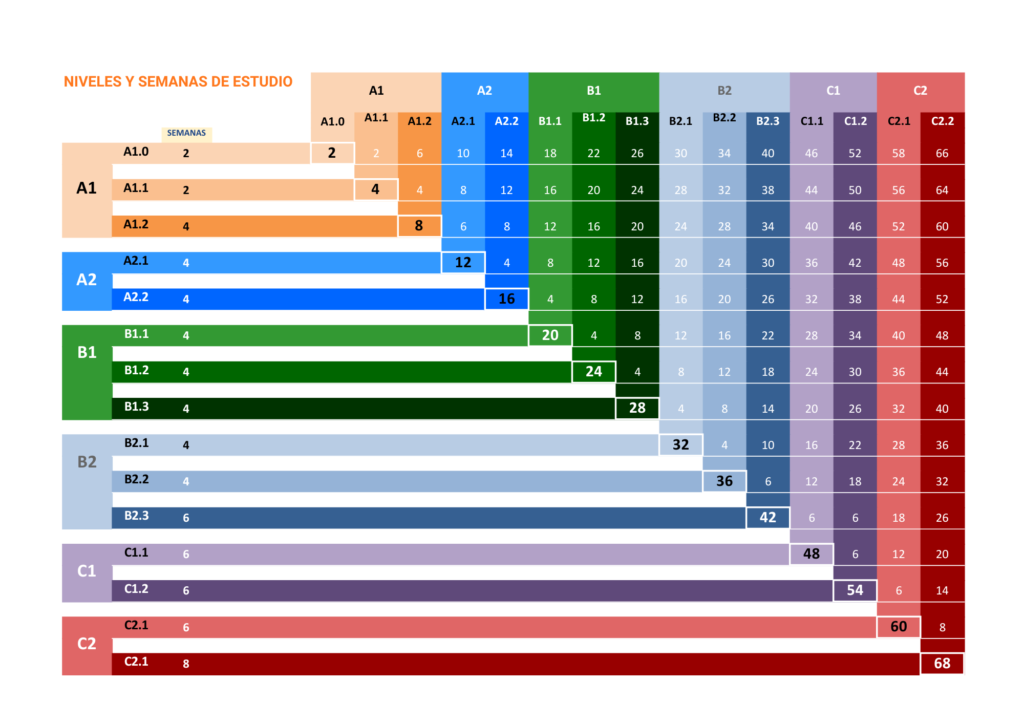
This scale shows the progression of the Spanish courses by level. E.g. To finish level A1 it is necessary to complete 8 weeks from A1.0 to A1.2.
C2 (Master)
Can understand with ease virtually everything heard or read. Can reconstruct information and arguments from different spoken and written sources, presenting them in a coherent, summarised presentation. Can express him/herself spontaneously, very fluently and precisely, differentiating finer shades of meaning even in more complex situations.
C1 (Effective Operational Proficiency)
Can understand a wide range of demanding, longer texts and recognise implicit meanings. Can express him/herself fluently and spontaneously without much obvious searching for expressions. Can use language flexibly and effectively for social, academic and professional purposes. Can produce clear, well-structured, detailed text on complex subjects, showing controlled use of organisational patterns, articulation and cohesion.
B2 (Advanced)
Can understand the main ideas of complex texts on both concrete and abstract topics, even if they are of a technical nature provided they are within his/her field of specialisation. Can interact with native speakers with a sufficient degree of fluency and spontaneity to ensure that communication is effortless for both partners. Can produce clear, detailed text on a wide range of subjects and explain a viewpoint on a topical issue giving the advantages and disadvantages of various options.
B1 (Threshold)
Can understand the main points of clear standard input on familiar matters regularly encountered in work, school, leisure and work-related situations. Can deal with most situations likely to arise whilst travelling in an area where the language is used. Can produce simple connected text on topics which are familiar or of personal interest. Can describe experiences, events, wishes and aspirations and briefly give reasons and explanations for opinions and plans.
A2 (Platform)
Can understand sentences and frequently used expressions related to areas of most immediate relevance (e.g. basic information about him/herself and his/her family, shopping, places of interest, occupations, etc.). Can communicate in simple and routine tasks requiring a simple and direct exchange of information on familiar and routine matters. Can describe in simple terms aspects of his/her background and environment as well as matters related to his/her immediate needs.
A1 (Access)
Can understand and use familiar everyday expressions and simple sentences aimed at the satisfaction of needs of a concrete type. Can introduce him/herself and others and can ask for and give basic personal information about home, possessions and people he/she knows. Can interact in a basic way provided the other person talks slowly and clearly and is prepared to cooperate.
Questions and Answers
Levels are your official roadmap (from A1 to C2) to measure your real progress according to international standards. Thanks to our chart, you can visualize exactly which stage you are at and how many weeks you need to reach your fluency goal.
It is the international standard that organizes language learning into 6 levels (A1 to C2). We use it so that your progress at our school is measurable and official. This allows any university or company in the world to understand exactly what skills you have when you say you have reached, for example, a B2 level.
It helps you visualize the actual time you need to move up a level. For example, if you start from scratch, you can see that in 8 weeks you will complete level A1, and in 16 weeks you will reach the end of A2. It is a transparency tool so you know what to expect at every stage of your learning journey.
We advise you to complement the classes with reading and audio at home. If you follow the chart and also practice outside the classroom, you will assimilate the content of each block in much less time.
The ideal approach is to lose the fear of making mistakes starting from level A1. If you make the most of each 55-minute session by participating, you will move from one color block to another with much more fluency and confidence.
We recommend checking the chart when you are finishing an "even" level (A2, B2, or C2). This is the point where your skills are most balanced to successfully obtain your official diploma.
The letters group your abilities: A is for basic communication, B for independence in speaking, and C for expert mastery. It is a universal system so that everyone understands what you are capable of doing.
Levels are divided into smaller parts to make progress easier. The .1 is the introduction to new content, and the .2 is where we consolidate and refine it before moving up to the next level.
To reach level C2 (Mastery) from scratch, 68 weeks are required. It is a long but steady path, designed so that every week adds a real communication skill.
Yes, the chart is a recommended average. If you have a natural talent or study intensively, our academic team can evaluate your progress. If you practice more outside of class, you might move up levels faster than expected.